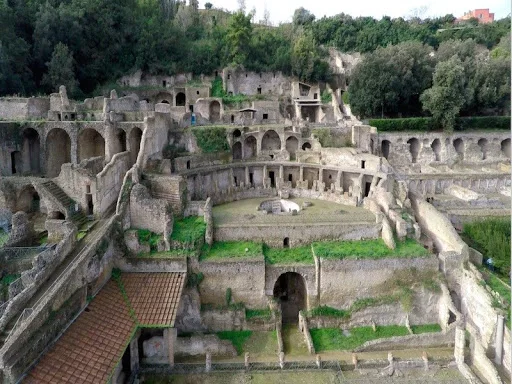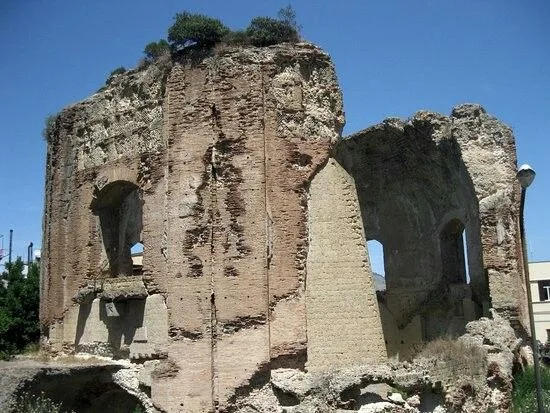
The Venus sector of the Baths of Baia preserves evidence of refined decoration within Roman bathing residences.
LISTEN TO THE STORY
Audio guide
Voice settings
Read the transcript
The Venus rooms illustrate how bathing could also involve visual pleasure and display.
The sector includes buildings of different periods. Decorated vaults and floors testify to the quality of the rooms; TESS records mosaics attributed to this group. The name does not establish the presence of a cult of Venus.
It must be distinguished from the large bathing building with an octagonal exterior and circular interior, now separated by Via Lucullo.
The name Venus comes from modern interpretation, not proof of a temple.
A nearby building is also known as the Temple of Venus: its historical connection is interesting, but the two places are not identical.
The baths on the hillside and the separate monument known as the Temple of Venus are distinct remains, although research suggests a relationship between them.
History
The sector includes buildings of different periods. Decorated vaults and floors testify to the quality of the rooms; TESS records mosaics attributed to this group. The name does not establish the presence of a cult of Venus.
It must be distinguished from the large bathing building with an octagonal exterior and circular interior, now separated by Via Lucullo. The Park proposes a relationship between that building and the rooms uphill, but the GoFlegrei records remain distinct because they are not the same space or access regime.
What to notice
- Traces of vault decoration.
- The variety of room geometries.
- The historical relationship with the building across the road, without confusing the two places.
Frequently asked questions
Is this the Temple of Venus?
No. It is the internal sector; the detached building has a separate record.
Does the name establish a cult?
No, it is a conventional name.