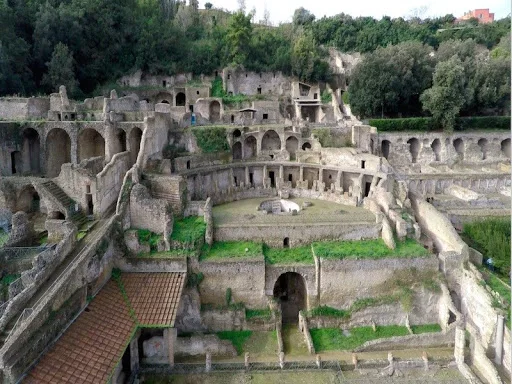
The Villa dell’Ambulatio’s terraces reveal how Roman residences at Baia were adapted to the hillside and bay.
LISTEN TO THE STORY
Audio guide
Voice settings
Read the transcript
A Roman hillside villa cannot be understood through one room alone.
Studies distinguish six terraced levels connected by stairs and passages. Early phases belong to the late Republican period, but the visible villa reflects later changes. Stone and mosaic floors reveal care in the design of the rooms.
The term ambulatio evokes walking and leisure but does not establish the function of every space. Reading the levels and retaining walls helps us imagine a residence overlooking the bay without attributing it to an undocumented owner.
Notice the successive levels: the hill becomes part of the architecture.
Floors tell us about the quality of the rooms, while stairs and porticoes organised movement.
Imagine sheltered spaces opening onto views of the bay without inventing details the remains cannot establish.
History
Studies distinguish six terraced levels connected by stairs and passages. Early phases belong to the late Republican period, but the visible villa reflects later changes. Stone and mosaic floors reveal care in the design of the rooms.
The term ambulatio evokes walking and leisure but does not establish the function of every space. Reading the levels and retaining walls helps us imagine a residence overlooking the bay without attributing it to an undocumented owner.
What to notice
- Successive terraces.
- Traces of decorated floors.
- Vertical connections and retaining walls.
Frequently asked questions
Is it a separate attraction?
It is part of the archaeological park.
How many levels are described?
Six terraces in the consulted documentation.